
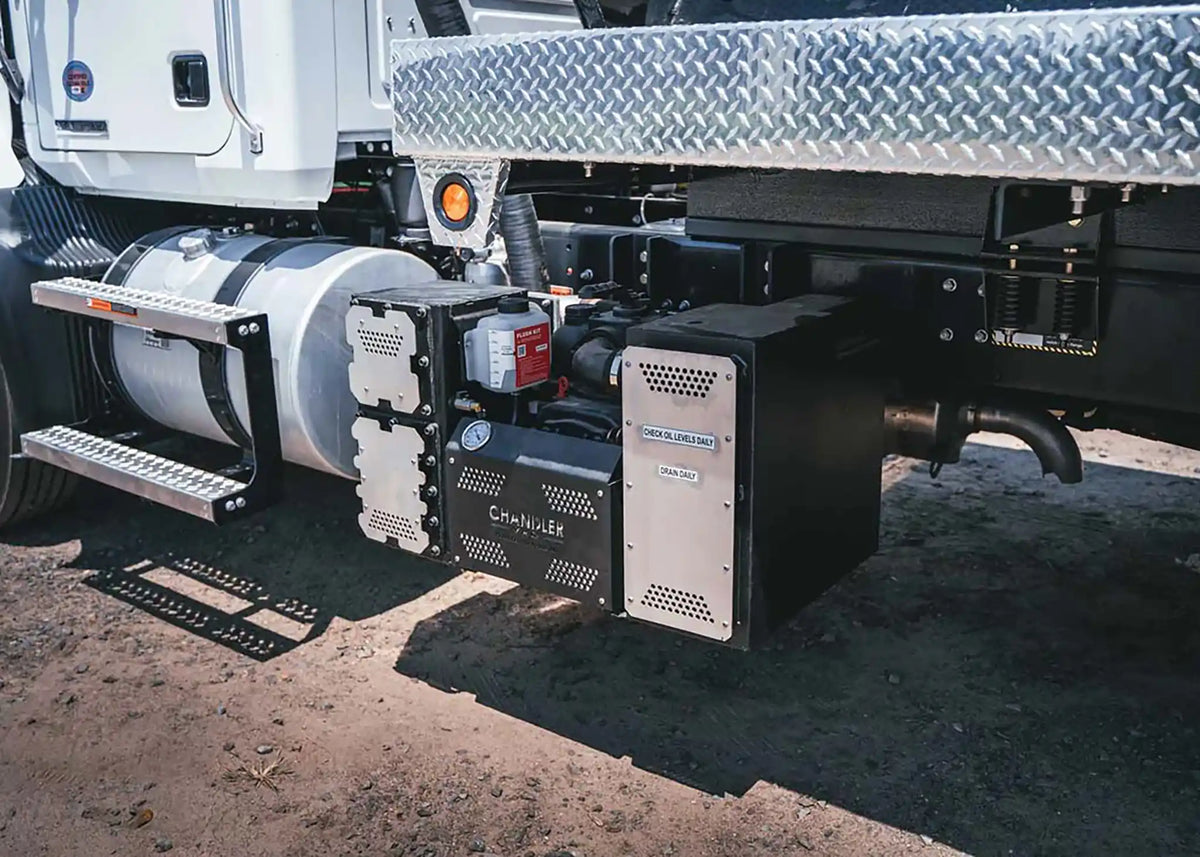
Selecting the right vacuum pump or blower for a vacuum truck is one of the most consequential decisions in vacuum truck design. The pump determines how quickly a truck can load, how much vacuum it can sustain, how the system handles heat, how much horsepower the PTO or hydraulic system must provide, and ultimately how productive the truck can be on a route.
For septic pumping, portable restroom service, liquid waste hauling, grease-trap service, hydro-excavation, and industrial vacuum applications, there is no universally "best" pump.
The correct choice depends on a wide range of factors, including: tank capacity, material being recovered, hose diameter and length, duty cycle, required vacuum, desired loading speed, available engine/PTO horsepower, operating environment, and maintenance philosophy.
The models in this comparison fall primarily into two technologies:
-
Rotary vane vacuum pumps - including the Battioni B1100, FAN 420, NVE 607, NVE 887, Masport Titan, and Masport Cobra.
-
Positive-displacement rotary-lobe vacuum blowers - including the Battioni BLW 210, NVE B500, and NVE 4310.
Understanding the difference between these technologies is more useful than simply comparing advertised CFM numbers. All models discussed throughout this article were selected by Arkson Truck Co. for their top-tier performance, and are optioned — depending on application — in a variety of our custom vacuum truck builds and configurations.
Vacuum Pump vs. Vacuum Blower: What's the Difference?
Although the terms are frequently used interchangeably in the vacuum-truck industry, a rotary vane pump and a rotary-lobe blower are mechanically different machines.
Rotary Vane Vacuum Pumps
 A rotary vane pump uses a rotor with sliding vanes that create changing chambers inside the pump housing. As the rotor turns, atmospheric air is drawn from the tank into the pump and discharged through the exhaust.
The vane design provides substantial vacuum capability in a relatively compact package.
Models such as the Battioni FAN 420, NVE 607, NVE 887, and Masport Cobra are examples of this architecture.
Rotary-Lobe Vacuum Blowers
 A blower uses two or more precisely synchronized lobed rotors. The rotors trap air between the lobes and housing and move that air from the inlet to the outlet.
The NVE B500 and 4310 use tri-lobe designs, while the Battioni BLW 210 uses a tri-lobe rotary-lobe configuration. These machines are particularly attractive when high airflow and continuous-duty operation are priorities.
The Most Important Difference: Vacuum vs. Airflow
One of the biggest mistakes when comparing vacuum equipment is looking exclusively at CFM.
CFM tells you how much air the machine can move under a particular operating condition. It does not, by itself, tell you how quickly a vacuum truck will load liquid or sludge.
As vacuum increases, airflow generally decreases.
For example, the NVE B500 is rated at 431 CFM free air at 2,400 RPM but is designed for continuous operation up to 24 in. Hg.
The NVE 887, meanwhile, is rated at 532 CFM and approximately 28 in. Hg maximum vacuum, with an operating range around 1,100–1,200 RPM.
That illustrates why 532 CFM vs. 431 CFM doesn't automatically mean the 887 will outperform the B500 in every application.
The actual system performance depends on the vacuum level required, hose losses, material characteristics, tank plumbing, pump temperature, and the rest of the truck's vacuum system components.
Pump and Blower Comparison at a Glance
|
Model |
Technology |
Approx. Airflow |
Vacuum Capability |
Typical Application |
|
Battioni B1100 / Ballast 11000 |
Rotary vane |
393 CFM |
28.5 in. Hg / 95% |
Heavy-duty septic & liquid waste |
|
Battioni FAN 420 |
Rotary vane |
423 CFM |
28.5 in. Hg / 95% |
Heavy-duty continuous/intermittent vacuum work |
|
Battioni BLW 210 |
Tri-lobe blower |
798 CFM |
Approx. 26 in. Hg / 0.88 bar |
High airflow & high-volume applications |
|
NVE 607 |
Rotary vane |
~380 CFM |
28 in. Hg |
Versatile septic/liquid waste |
|
NVE 887 |
Rotary vane |
532 CFM |
28 in. Hg |
High-capacity vacuum pumping |
|
NVE B500 |
Tri-lobe blower |
431 CFM @ 2,400 RPM |
24 in. Hg continuous |
Moderate-duty, continuous operation |
|
NVE 4310 |
Tri-lobe blower |
940 CFM @ 4,500 RPM |
High-vacuum application |
High-volume industrial/liquid waste |
|
Masport Titan |
Rotary vane |
~343–377 CFM |
27 in. Hg intermittent |
Proven general-purpose vacuum work |
|
Masport Cobra |
Rotary vane |
532 CFM |
27 in. Hg intermittent |
3,000–8,000 gallon tanks |
*Manufacturer ratings are not directly equivalent because manufacturers use different test conditions, RPM ranges, terminology, and duty-cycle specifications. Actual truck performance depends on the complete system.
Battioni B1100 / Ballast 11000
The Battioni B1100 commonly refers to the Ballast 11000 configuration used in vacuum-truck pump packages. Current pump packages are rated around 393 CFM, 28.5 in. Hg maximum vacuum, 2.5 bar/36 psi maximum working pressure, and approximately 28.2 hp at maximum vacuum.
 The pump operates in the 1,200–1,400 RPM range and weighs approximately 720 lb in the Spartan package configuration.
Advantages
- High vacuum capability
- Excellent fit for septic and liquid-waste applications
- Relatively moderate operating RPM
- Automatic lubrication
- Crash Protection System
- Built-in secondary and muffler options in packaged configurations
- Strong balance between airflow and vacuum
- Well suited to 2,000–4,000+ gallon truck applications
The Crash Protection System is particularly valuable in real-world vacuum service because vane failure or foreign-material ingestion can otherwise result in severe pump damage. The Battioni design uses a sliding flange mechanism intended to protect the housing and rotor.
Disadvantages
- Heavy compared with some smaller vane pumps
- Requires oil lubrication
- Generates heat during extended high-vacuum operation
- Lower free-air CFM than larger blowers
- Not necessarily the best choice where extremely high continuous airflow is the primary objective
Best Application
The B1100 is a strong all-around heavy-duty choice for septic vacuum trucks and liquid-waste trucks, particularly when high vacuum and proven vane-pump architecture are more important than maximum airflow.
Battioni FAN 420
The FAN 420 is another rotary vane pump, rated at approximately 423 CFM, 1,500 RPM maximum, 95% vacuum/28.5 in. Hg, and 2.5 bar/36 psi working pressure.
 Its distinguishing feature is its cooling strategy.
Battioni uses forced fresh-air cooling, while the FAN 420 can also be equipped with air-injection cooling for extended high-vacuum operation. Battioni specifically positions the FAN for heavy-duty applications.
Advantages
- 423 CFM capacity
- Approximately 28.5 in. Hg maximum vacuum
- Automatic lubrication
- Long-life vanes
- Crash Protection System
- Forced-air cooling
- Air-injection cooling capability
- Available in clockwise and counterclockwise rotation
- Strong heavy-duty application capability
Disadvantages
- Approximately 397 lb as a bare pump
- Higher heat-management requirements than a simple low-duty application
- Requires lubrication
- More complex cooling architecture than some basic vane pumps
- Package dimensions and weight need to be considered during body/chassis design
Best Application
The FAN 420 is particularly attractive for heavy-duty vacuum trucks that need high vacuum combined with good sustained-duty thermal management.
Its cooling architecture is one of its biggest differentiators.
Battioni BLW 210 Blower
The BLW 210 moves into a different category.
Battioni describes the BLW as a rotary-lobe vacuum pump using two tri-lobe rotors and minimal internal clearances. The BLW line is oil-free and water-free in the pumping chamber and uses air injection for cooling.
 The BLW 210 is rated around 798 CFM, up to 1,200 RPM, with approximately 0.88 bar/36 in. Hg maximum vacuum specification depending on the stated test/configuration, and 40 kW of power at maximum pressure.
Advantages
- Extremely high airflow
- Tri-lobe design
- Oil-free pumping chamber
- Water-free operation
- High-volume air movement
- Excellent candidate for high-volume liquid recovery
- Air-injection cooling
- Vacuum/pressure operation
- Lower internal contamination risk because the pumping chamber does not require oil
Disadvantages
- Heavier than some vane pumps
- Requires significantly more drive power than smaller pumps at comparable operating conditions
- High RPM and system design requirements can complicate installation
- High airflow doesn't necessarily translate into higher performance with every material
- Requires careful protection from liquid and solids entering the blower
- More demanding system engineering
Best Application
The BLW 210 makes the most sense where high airflow and high-volume material recovery justify the additional system complexity.
It’s especially well-suited for larger liquid-waste and industrial vacuum applications.
NVE 607 Challenger
The NVE 607 is one of the established workhorses of the liquid-waste industry.
NVE's published specifications identify the 607 as a rotary vane vacuum pump around 380 CFM, with approximately 28 in. Hg maximum vacuum, 3-inch porting, and operating speeds generally in the 1,100–1,250 RPM range for current guidance.
 Historical NVE performance data shows approximately 357 CFM at free flow at 1,500 RPM, with approximately 244 CFM at 27 in. Hg under those test conditions. NVE cautions that operating vacuum depends on RPM, temperature, altitude, as well as operating duration.
Advantages
- Proven rotary-vane design
- Strong vacuum capability
- Relatively low operating RPM
- Excellent aftermarket familiarity
- Available fan- and liquid-cooled configurations
- Good balance for medium-size septic trucks
- Multiple drive options
- NVE's current Challenger warranty (*subject to change) includes two years against manufacturing defects and a lifetime warranty on the rotary-vane casing against cracking.
Disadvantages
- Lower airflow than the 887
- Requires lubrication
- Thermal management remains important
- 3-inch plumbing can become a restriction in higher-volume applications
- Not as well suited to very high airflow requirements as a large tri-lobe blower
Best Application
The 607 is an excellent choice for medium-duty septic and liquid-waste vacuum trucks, particularly 2,000–3,000 gallon configurations where a compact, proven rotary vane pump is desirable.
NVE 887 Challenger
The NVE 887 is a step up in airflow from the 607.
 It produces approximately 532 CFM, operates around 1,100–1,200 RPM, uses 4-inch porting, and is rated around 28 in. Hg full vacuum. NVE's product literature identifies fan/ballast-port cooling and a seven-vane configuration.
Advantages
- 532 CFM
- Approximately 28 in. Hg vacuum
- 4-inch porting
- High airflow without moving to a tri-lobe blower
- Vacuum-controlled ballast air cooling
- Four-point automatic lubrication
- Integral final filter
- Vane inspection access
- Crash protection
- Hydraulic or gearbox drive options
- Strong fit for larger vacuum trucks
Disadvantages
- Approximately 620 lb
- More expensive than smaller 607-type systems
- Higher horsepower requirements
- Requires careful thermal management
- Larger physical footprint
- Still dependent on lubrication and vane maintenance
Best Application
The 887 is particularly compelling for use in larger septic trucks, commercial liquid-waste trucks, and operators who want higher airflow while retaining the characteristics of a rotary vane pump.
NVE B500 Blower
The NVE B500 represents a different philosophy.
 NVE describes it as an entry-level tri-lobe vacuum blower designed for moderate applications and 3-inch plumbing. Its current specification is 431 CFM at 2,400 RPM, approximately 24 in. Hg maximum vacuum, and 15 psi maximum pressure. NVE specifies continuous operation to 24 in. Hg.
The B500 is oil-less in the pumping chamber and uses air-injection cooling.
Advantages
- Oil-less pumping chamber
- 431 CFM
- Continuous duty to 24 in. Hg
- Tri-lobe rotor design
- Air-injection cooling
- Built-in vacuum/pressure changeover
- Lower maintenance requirements inside the pumping chamber
- 3-inch plumbing compatibility
- Comparatively compact blower architecture
Disadvantages
- Lower maximum vacuum than the 607, 887, FAN 420, and B1100
- Higher operating RPM than rotary vane pumps
- 3-inch plumbing limits maximum system airflow
- Not intended for maximum-duty large industrial applications
- Requires careful protection from liquid contamination
- High-speed blower installation requires appropriate gearing/drive design
Best Application
The B500 is a solid option for moderate-duty septic, portable restroom, and liquid-waste trucks where continuous operation, oil-less blower technology, and straightforward maintenance are priorities.
It’s routinely deployed on both medium-duty Mack MD7 chassis as well as larger Kenworth T480 configurations, illustrating how the same blower architecture can be incorporated into substantially different truck packages.
NVE 4310 Blower
At the high end of the blower category is the NVE 4310.
 This is a heavy-duty tri-lobe blower rated at approximately 940 CFM at 4,500 RPM. NVE recommends approximately 4,000 RPM for normal operation and allows 4,500 RPM for intermittent operation.
The 4310 requires approximately 51.4 hp at 27 in. Hg at 4,000 RPM and approximately 58 hp at 4,500 RPM.
Advantages
- Extremely high airflow
- 940 CFM free-air rating
- Tri-lobe helical rotor design
- Oil-less operation
- Continuous-duty capability at maximum vacuum
- Ballast air cooling
- 4-inch porting
- Lower pulsation and noise characteristics than earlier tri-lobe designs
- Integral final filtration
- Excellent high-volume performance
Disadvantages
- Requires substantial horsepower
- High operating RPM
- Approximately 456 lb
- More demanding driveline/gearbox requirements
- High heat generation at extreme operating conditions
- Significantly more expensive system than a small vane pump
- Excess capacity can be economically wasteful on smaller trucks
Best Application
The 4310 is best suited for high-volume industrial vacuum, large liquid-waste, municipal, and other demanding continuous-duty applications.
Throwing a 4310 on a small septic truck simply because "940 CFM is better" would be poor system engineering.
Masport Titan
The Masport Titan is a rotary vane vacuum/pressure pump with a long history in vacuum-truck applications.
 Published performance data shows approximately 343 CFM displacement at 1,200 RPM and 377 CFM at 1,400 RPM, with approximately 27 in. Hg intermittent maximum vacuum.
Masport also incorporates an automatic mechanical oil pump and heat-stabilized Kevlar vanes.
Advantages
- Proven rotary-vane architecture
- Approximately 343–377 CFM depending on RPM/version
- 27 in. Hg intermittent vacuum
- Automatic lubrication
- Kevlar vane technology
- Good general-purpose performance
- Established service familiarity
- Suitable for many medium-sized vacuum trucks
Disadvantages
- Lower airflow than the NVE 887
- Lower vacuum rating than some competing heavy-duty pumps
- 27 in. Hg is specified as intermittent rather than continuous
- Requires lubrication
- Heat management is important during long high-vacuum cycles
Best Application
The Titan remains a strong choice for general septic and liquid-waste applications where proven vane-pump performance and serviceability are more important than maximum airflow.
Masport Cobra
The Masport Cobra moves toward the high-capacity end of the rotary-vane category.
 Masport rates the Cobra at 532 CFM and specifically markets it for 3,000–8,000 gallon tanks. It uses 4-inch NPT connections and is designed to achieve a minimum of 27 in. Hg intermittently.
Advantages
- 532 CFM
- 4-inch connections
- Designed around large 3,000–8,000 gallon tanks
- Large cooling fan
- Heat-stabilized Kevlar vanes
- Automatic mechanical oil pump
- Heavy-duty bearings
- Integrated vacuum/pressure changeover valve
- Stainless inlet filter
- Vacuum relief valve
- End-thrust protection
Disadvantages
- Primarily suited to larger truck packages
- Requires substantial drive power
- Rotary-vane lubrication requirements
- Intermittent maximum vacuum specification
- Larger and heavier system than smaller pumps
Best Application
The Cobra is particularly attractive for large septic and liquid-waste trucks where approximately 500+ CFM airflow is desirable without moving to a rotary-lobe blower.
Rotary Vane vs. Rotary-Lobe Blower: Technical Comparison
|
Characteristic |
Rotary Vane Pump |
Rotary-Lobe Blower |
|
Vacuum capability |
Generally excellent |
Good to excellent depending on model |
|
Airflow |
Moderate to high |
High to extremely high |
|
Operating RPM |
Generally lower |
Generally higher |
|
Lubrication |
Required |
Pumping chamber is typically oil-less |
|
Continuous-duty potential |
Model-dependent |
Excellent on appropriate models |
|
Heat management |
Important |
Critical at high differential pressure |
|
Maintenance |
Vane/oil/filter service |
Filters, bearings, timing gears, cooling system |
|
Liquid contamination tolerance |
Requires protection |
Requires very good separation/protection |
|
High-volume loading |
Good |
Excellent |
|
High-vacuum loading |
Excellent |
Model-dependent |
|
System complexity |
Moderate |
Moderate to high |
|
Best fit |
Septic/liquid waste |
High-volume/industrial/continuous duty |
|
Typical RPM |
~900–1,500 |
~2,400–4,500+ |
|
Oil-free pumping chamber |
No |
Yes |
Why Tank Size Changes the Pump Decision
Pump selection should never be separated from tank capacity.
A 1,200-gallon portable restroom truck does not necessarily benefit from a 940-CFM industrial blower.
Conversely, installing a relatively small pump on a 5,000-gallon liquid-waste truck can create unnecessarily long loading cycles.
A useful engineering approach is to consider:
Tank volume + material + hose system + desired cycle time + duty cycle = pump requirement
For example:
1,200–2,000 Gallon Truck
A 607, Titan, B1100, FAN 420, or B500 may be appropriate depending on application.
2,000–3,500 Gallon Truck
The B1100, FAN 420, 887, Cobra, or B500 become increasingly relevant.
3,500–5,000+ Gallon Truck
The 887, Cobra, BLW 210, or 4310 may make sense depending on the waste stream and desired loading performance.
These are engineering starting points, not hard capacity limits. A pump should be selected from the actual operating requirements rather than a simple gallons-to-CFM formula.
Hose Diameter Matters More Than Many Buyers Realize
A pump's airflow rating can be undermined by restrictive plumbing.
A 4-inch pump connected to restrictive 3-inch plumbing cannot deliver the same system performance as a properly sized 4-inch system.
Pressure drop increases with flow and is affected by:
- Hose diameter
- Hose length
- Number of elbows
- Valve design
- Fittings
- Tank inlet configuration
- Material viscosity
- Debris accumulation
This is one reason the NVE 887 and Cobra's 4-inch porting is relevant for higher-volume systems, while the B500 is deliberately designed around a 3-inch system.
The pump, plumbing, valves, separator, tank inlet, and hose should be engineered as one system.
The Importance of Heat Management
Heat is one of the biggest constraints on vacuum-pump performance.
As vacuum increases, the pump works harder. Higher RPM, higher ambient temperature, longer operating time, and greater pressure differential all increase thermal load.
NVE specifically warns that increasing RPM, ambient temperature, and operating duration increase blower temperature. Its 4310 guidance calls for monitoring exhaust temperature and keeping it below 380°F, with 4,500 RPM limited to intermittent use.
Battioni addresses this issue in the FAN and BLW families through forced-air and air-injection cooling technologies.
This is why maximum vacuum should never be confused with recommended continuous operating vacuum. A pump may technically achieve a certain vacuum level while not being designed to operate there continuously.
Rotary Vane Pump Pros and Cons
Advantages
Higher vacuum potential
Rotary vane pumps are exceptionally effective when high vacuum is required.
Lower operating RPM
Many truck-mounted vane pumps operate in the roughly 900–1,500 RPM range.
Excellent septic performance
Their combination of vacuum and airflow makes them particularly effective for septic and liquid-waste applications.
Compact power density
They can provide significant vacuum performance without requiring the very high rotational speeds of some blowers.
Proven technology
The technology has been used extensively in vacuum trucks for decades.
Disadvantages
Lubrication requirements
Oil level and oil delivery must be maintained.
Vane wear
Vanes are wear components and eventually require inspection/replacement.
Thermal limitations
Extended high-vacuum operation generates significant heat.
Liquid contamination risk
Separators, filters, float shutoffs, and proper operating procedures are critical.
Rotary-Lobe Blower Pros and Cons
Advantages
Very high airflow
Large blowers can dramatically increase air-moving capacity.
Oil-less pumping chamber
Tri-lobe blowers do not require oil inside the air chamber.
Excellent continuous-duty capability
Properly engineered blowers can operate continuously at high vacuum.
High-volume applications
They are particularly attractive for large tanks and industrial vacuum applications.
Reduced vane maintenance
There are no sliding vanes inside the pumping chamber.
Disadvantages
Higher RPM
Large blowers can require 2,400–4,500+ RPM.
Higher horsepower requirements
The NVE 4310, for example, requires more than 50 hp at 27 in. Hg.
Heat remains a major concern
High differential pressure produces significant thermal load.
Greater system sensitivity
Gear ratios, plumbing, cooling, filtration, and protection systems must be correctly engineered.
Can be oversized
A high-CFM blower can add cost, weight, and horsepower requirements without producing a meaningful benefit on a smaller truck.
Which Is Better for a Septic Vacuum Truck?
For the majority of conventional septic pumping applications, rotary vane pumps remain an excellent choice.
The Battioni B1100, FAN 420, NVE 607, NVE 887, Masport Titan, and Masport Cobra all provide combinations of vacuum, airflow, and pressure performance well suited to liquid-waste work.
However, blowers become increasingly attractive as tank capacity, duty cycle, and required airflow increase.
A B500 can be an excellent solution when continuous operation to 24 in. Hg and oil-less blower technology are desirable. The BLW 210 and NVE 4310 become more compelling when very high airflow and high-volume continuous-duty performance justify the additional power and system requirements.
Which Is Better for Portable Restroom Trucks?
Portable restroom trucks have somewhat different requirements.
Because portable restroom waste is generally liquid and routes can involve many short pumping cycles, operators often benefit from:
- Fast pump-down
- High reliability
- Compact installation
- Easy maintenance
- Appropriate tank capacity
- Good vacuum performance
- Fast recovery between service locations
A B1100, FAN 420, NVE 607, NVE 887, or B500 can all make sense depending on tank size and route requirements.
For a compact portable restroom truck, an over-spec'd 798- or 940-CFM blower may add unnecessary weight, horsepower requirements, and cost.
Which Is Better for Industrial Vacuum Trucks?
Industrial applications are where the equation changes.
If the truck is expected to perform:
- Long-duration vacuum cycles
- Large-volume material recovery
- Deep excavation
- Industrial liquid recovery
- Large tank loading
- Continuous-duty operations
then the airflow advantage of a large blower can become much more valuable.
The Battioni BLW 210 and NVE 4310 are particularly interesting in these applications.
However, the material itself matters. Heavy sludge, solids, debris, water, and abrasive material can all affect the ideal pump configuration.
The Most Important Consideration: Design the Entire Vacuum System
A vacuum pump is only one component of a quality vacuum truck build.
At Arkson Truck Co., we evaluate the complete system:
Chassis → PTO → driveline → pump/blower → gearbox → plumbing → separator → tank → valves → hose → operator controls
Every component affects overall performance.
A 532-CFM pump connected to restrictive plumbing may perform worse than a properly engineered 400-CFM system.
Likewise, a 940-CFM blower doesn't automatically make a truck faster if the tank inlet, hose, valves, or separator restrict airflow.
The best vacuum truck is therefore not the truck equipped with the highest advertised CFM unit, it’s the truck with the best-matched vacuum system relative to its intended application.
Arkson Truck Co.'s Approach to Vacuum System Selection
When specifying a vacuum truck, Arkson Truck Co. can evaluate pump and blower selection based on the actual application rather than selecting equipment from a generic catalog.
Important inputs include:
- Tank capacity
- Waste material
- Average job volume
- Desired pumping time
- Hose diameter
- Hose length
- Operating RPM
- Available PTO horsepower
- Hydraulic capacity
- Duty cycle
- Ambient temperature
- Altitude
- Required vacuum level
- Required pressure
- Chassis GVWR
- Axle loading
- Available installation space
- Maintenance requirements
- Operator workflow
That engineering approach can help determine whether a Battioni B1100, FAN 420, BLW 210, NVE 607, NVE 887, B500, 4310, Masport Titan, or Masport Cobra is the appropriate solution.
Final Recommendation
In the vacuum truck manufacturing industry, there is no universal winner between vacuum pumps and blowers.
Choose a rotary vane pump when high vacuum, moderate-to-high airflow, lower operating RPM, and proven septic/liquid-waste performance are priorities.
Choose a rotary-lobe blower when high airflow, continuous-duty operation, and high-volume material recovery justify the additional horsepower, RPM, and system engineering.
For many septic and portable sanitation applications, the Battioni B1100, FAN 420, NVE 607, NVE 887, and Masport Titan/Cobra offer excellent performance. For higher-volume applications, the NVE B500, Battioni BLW 210, and NVE 4310 provide compelling blower alternatives.
The most important specification is ultimately how the pump performs as part of the complete vacuum truck system.
Pump selection should be designed around the tank, material, route, duty cycle, chassis, and operator — not the other way around.
That’s the difference between simply mounting a pump on a truck, and engineering a high-performance vocational vacuum truck from the ground up.
Reach out to the team at Arkson Truck Co today, to start your custom vacuum truck build the right way. We’ll cut through the weeds, and help you select the optimal vacuum system designed around your business.
Share:
Commercial Truck Tire Maintenance: A Complete Guide for Fleets
Interior Maintenance Tips for Vocational Truck Fleets