
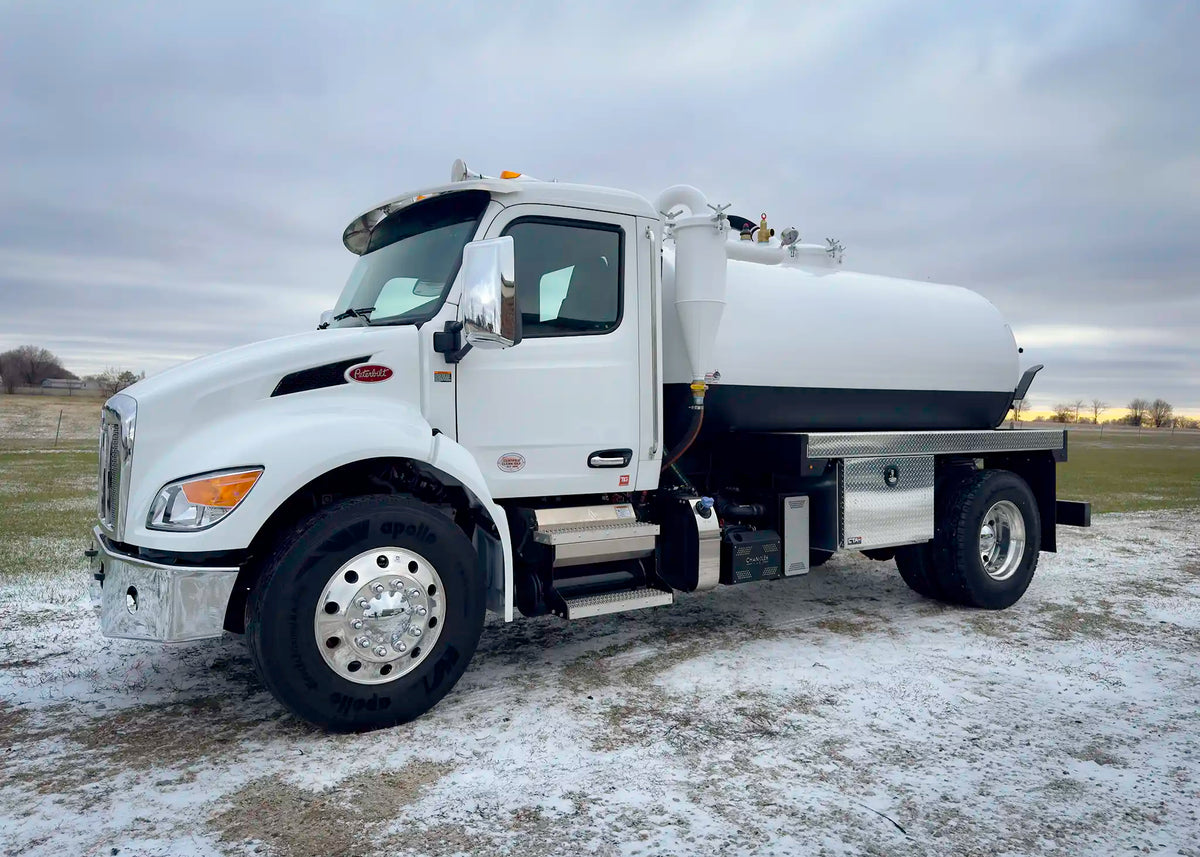
A vacuum truck is only as effective as the chassis underneath it.
For septic pumping, portable restroom service, industrial vacuuming, liquid-waste hauling, hydro-excavation, municipal work, and combination vacuum applications, the chassis determines far more than how the truck looks.
Aspects like GVWR, axle ratings, wheelbase, frame strength, cab-to-axle dimensions, drivetrain configuration, PTO compatibility, payload capacity, and serviceability all influence how much equipment the truck can carry and how effectively it can perform.
For Arkson Truck Co., chassis selection is a from-the-ground-up engineering decision.
The chassis must be matched appropriately to the tank capacity, vacuum pump or blower, hose and plumbing system, payload, operating environment, route conditions, and expected duty cycle.
This guide compares the Mack MD6 and MD7, Western Star 47X, Freightliner M2-106 and FLD-114, International MV-607 and HV-607, Kenworth T280, T380, T480 and T880, and Peterbilt 536, 537, 548 and 567.
Important: Chassis specifications vary by model year, axle package, suspension, wheelbase, engine, transmission, and customer-selected options. The specifications below should be treated as application guidance, not a substitute for an OEM build sheet or final engineering review. Contact Arkson Truck Co. for expert guidance on your final chassis selection.
Arkson Vacuum Truck Chassis Comparison at a Glance
|
Chassis |
General Class |
Typical GVWR Capability |
4x2 |
4x4 / AWD |
Best Vacuum-Truck Applications |
|
Mack MD6 |
Class 6 |
25,995 lb |
✓ |
— |
Compact septic, portable restroom, light liquid waste |
|
Mack MD7 |
Class 7 |
33,000 lb |
✓ |
— |
Medium-duty septic and liquid waste |
|
Western Star 47X |
Class 7/8 |
Configuration dependent |
✓ |
✓ |
Severe-duty, industrial, off-road vacuum |
|
Freightliner M2-106 |
Class 6–8 |
Up to 66,000 lb depending configuration |
✓ |
✓ |
Broad range of vacuum applications |
|
Freightliner FLD-114 |
Legacy Class 8 |
Configuration dependent |
✓ |
Configuration dependent |
Used/heavy-duty vacuum truck builds |
|
International MV-607 |
Medium Duty |
21,500–54,700 lb range |
✓ |
— |
Septic, liquid waste, municipal |
|
International HV-607 |
Severe Duty |
Configuration dependent |
✓ |
✓* |
Heavy-duty/severe-service vacuum |
|
Kenworth T280 |
Class 6/7 |
Up to ~26,000 lb |
✓ |
✓ |
Compact and medium-duty vacuum |
|
Kenworth T380 |
Class 7 |
Up to 33,000 lb |
✓ |
✓ |
Medium-duty septic/liquid waste |
|
Kenworth T480 |
Class 8 |
Up to 66,000 lb |
✓ |
✓ |
Large tanks, industrial and severe vocational |
|
Kenworth T880 |
Class 8 |
Configuration dependent |
✓ |
✓* |
Heavy-duty and high-capacity vacuum |
|
Peterbilt 536 |
Class 6 |
Up to 26,000 lb |
✓ |
✓ / AWD |
Compact vacuum applications |
|
Peterbilt 537 |
Class 7 |
Up to 33,000 lb |
✓ |
✓ / AWD |
Medium-duty vacuum trucks |
|
Peterbilt 548 |
Class 8 |
Up to 66,000 lb |
✓ |
✓ / AWD |
Heavy medium-duty/severe vocational |
|
Peterbilt 567 |
Class 8 |
Up to 100,000 lb |
✓ |
Configuration dependent |
Large industrial, municipal and severe-duty vacuum |
* Availability depends on the specific model/configuration. Verify the current OEM build specification with an Arkson Truck Co. representative before ordering.
What Makes a Good Vacuum Truck Chassis?
Before comparing individual manufacturers, it helps to understand what actually matters; a good vacuum truck chassis needs to provide five things:
1. Adequate Payload
A vacuum truck's payload isn't simply the tank's rated capacity; a 3,000-gallon tank does not necessarily mean the truck can legally carry 3,000 gallons of liquid.
Water weighs approximately 8.34 lbs per gallon. That means 3,000 gallons of water represents roughly 25,000 lb before accounting for:
- Tank weight
- Pump/blower
- PTO
- Plumbing
- Hose
- Hose reels
- Separators
- Valves
- Toolboxes
- Fuel
- Driver
- Equipment
- Mounting hardware
Waste streams may have different densities, making payload calculations even more important.
This is why a chassis must be selected based on actual operating weight and axle loading, not tank volume alone.
2. Frame Strength
Vacuum trucks impose loads differently than conventional dry-van or other vocational truck applications.
The tank creates concentrated and dynamic loads on the frame. A full tank can also change axle loading substantially depending on:
- Tank location
- Wheelbase
- Baffle design
- Rear overhang
- Pump location
- Hose reel location
- Auxiliary equipment
- Lift axles
A strong frame is especially important for trucks operating on construction sites, industrial facilities, unpaved off-camber roads, or other severe-duty environments.
3. Wheelbase and Cab-to-Axle Dimension
Wheelbase is one of the most overlooked vacuum-truck specifications.
A longer wheelbase can provide better weight distribution and packaging space, but it also increases turning radius.
A shorter wheelbase improves maneuverability but may make it more difficult to distribute a large tank and auxiliary equipment correctly.
For urban septic and portable restroom routes, maneuverability can be more valuable than extreme payload.
For large industrial vacuum trucks, the priorities may be completely different.
4. PTO and Power Availability
The vacuum pump is effectively the heart of your truck’s vacuum system.
Rotary-vane pumps may require substantial PTO horsepower at high vacuum, while large tri-lobe blowers can require even more.
The chassis therefore needs an appropriate:
- PTO
- Transmission
- PTO gear ratio
- Driveline
- Engine torque curve
- And Hydraulic system, if applicable
This is particularly important for high-output systems like the larger NVE, Battioni, or Masport vacuum equipment we option.
5. Drive Configuration
For many septic routes, 4x2 is sufficient.
The truck spends most of its time on paved roads and only occasionally enters gravel driveways or construction sites.
But if your vacuum truck will routinely deal with navigating:
- Mud
- Sand
- Snow
- Construction sites
- Oilfields
- Quarries
- Remote rural locations
- Unimproved roads
then 4x4/AWD can be a major operational advantage in the field.
The tradeoff is the additional weight, cost, mechanical complexity, and potentially increased fuel consumption.
Vacuum Truck Chassis Comparison
Mack MD6: Compact Medium-Duty Vacuum Truck Platform

The Mack MD6 is a Class 6 chassis with a 25,995-lb GVWR. Mack positions the MD Series specifically for medium-duty vocational applications, including tank trucks. The MD6 is available in 4x2 configurations and has been designed with maneuverability in mind.
Mack provides a range of wheelbases and cab-to-axle configurations, allowing the chassis to be matched to different body lengths and weight distributions.
Why the MD6 works for vacuum trucks
The MD6 makes sense when the objective is a compact, maneuverable vacuum truck rather than a maximum-capacity unit.
Potential applications include:
- Portable restroom service
- Small septic routes
- Grease-trap service
- Light liquid waste
- Municipal sanitation
- Urban service routes
Advantages
- 25,995-lb GVWR
- Excellent urban maneuverability
- Compact dimensions
- Medium-duty operating costs
- Strong body-builder integration
- 4x2 configuration
- Potentially attractive for non-CDL applications depending on payload and regulations
Limitations
The MD6's biggest limitation is payload.
A large vacuum tank can quickly consume the available GVWR. For that reason, it is generally better suited to smaller vacuum systems.
Mack MD7: A Step Up in Vacuum Truck Capacity

The Mack MD7 moves into Class 7 with a 33,000-lb GVWR.
Mack positions the MD7 as a medium-duty vocational truck available in 4x2 configurations and suitable for applications including various tank trucks.
That additional GVWR can make a meaningful difference for vacuum truck applications.
Best applications
The MD7 is well suited for:
- Medium-size septic trucks
- Portable restroom trucks
- Municipal vacuum trucks
- Liquid-waste service
- Combination sanitation applications
Why choose MD7 instead of MD6?
The answer is primarily payload capacity.
If the tank, pump, and equipment package pushes an MD6 close to its GVWR, moving to an MD7 can provide valuable additional operating margin.
For many operators, the MD7 represents a useful middle ground between a compact medium-duty truck and a substantially heavier Class 8 chassis.
Western Star 47X: Serious Vocational Capability

The Western Star 47X is a completely different proposition.
Western Star designed the 47X specifically around demanding vocational applications. Its chassis incorporates high-strength frame options, splayed rails, aluminum crossmembers, and extensive PTO and body-builder provisions.
They emphasize the platform’s quick upfit capability, and offer multiple PTO configurations, including FEPTO, REPTO and transmission-mounted PTO options.
Why that matters for vacuum trucks
A high-capacity vacuum truck often requires substantial auxiliary power.
A chassis that provides broad PTO and equipment-packaging options can make the body integration process significantly easier (which can help shorten lead-times for your truck build).
Advantages
- Heavy-duty vocational frame
- Strong upfit platform
- Excellent PTO flexibility
- High axle-capacity potential
- Severe-duty orientation
- 4x4 configurations are available in the marketplace
- Excellent fit for construction and industrial environments
Best applications
The 47X is particularly suited for: Industrial vacuum trucks, large liquid-waste trucks, hydro-excavation support trucks, municipal equipment and severe-duty vacuum applications.
For a typical urban septic route, however, it may be more chassis than necessary.
Freightliner M2-106: One of the Most Versatile Vacuum Truck Platforms

The Freightliner M2-106 is one of the broadest platforms in this comparison.
Freightliner's M2-106 Plus options 4x2, 4x4 and 6x4 configurations, with Class 6–8 capability and front/rear axle options spanning a wide range.
Why it is attractive for vacuum trucks
The M2-106 can be configured for applications ranging from relatively compact medium-duty equipment to significantly heavier vocational packages.
Its vac-body-builder-friendly characteristics include:
- Clear frame rails
- Multiple axle configurations
- Wide engine selection
- Multiple suspension choices
- PTO compatibility
- 4x4 availability
Best applications
The M2-106 can be an excellent foundation for:
- Septic vacuum trucks
- Portable restroom trucks
- Grease trucks
- Liquid-waste trucks
- Municipal vacuum equipment
- Combination delivery/service trucks
One important caveat
"M2-106" doesn't describe a single GVWR configuration; the actual chassis specification of the M2-106 matters.
A buyer comparing an M2-106 to another chassis should compare the spec sheet, axle ratings, wheelbase, frame, engine, transmission and GVWR, not merely the model name — at Arkson Truck Co we’ll take the guesswork out of your purchase so you can rely on our expert guidance to ensure your chassis is appropriately sourced.
Freightliner FLD-114: The Legacy Heavy-Duty Option

The Freightliner FLD-114 is a legacy chassis which later evolved into the modern 114SD, so it deserves a different treatment from more current-production platforms.
You’ll likely encounter FLD-114 vacuum trucks on the used market, and they’ve been common workhorses in older fleets.
The chassis can still be attractive for vacuum truck builds because of their robust frame options, substantial engines, and heavy axle packages.
Advantages
- Proven heavy-duty architecture
- Large used-market availability
- Potentially strong payload capability
- Familiarity among commercial truck technicians
- Can be an economical foundation for a vacuum truck build
Disadvantages
- Platform Age
- Potentially high mileage (on used units)
- Older emissions technology
- Limited availability of specific configurations
- Less modern electrical architecture
- Condition varies dramatically between individual trucks on the used market
For an operator considering purchasing an FLD-114 for their vacuum truck build, or on the used market, the individual truck's configuration (and condition) matters more than the model badge.
International MV-607: A Strong Medium-Duty Vacuum Platform

The International MV-607 is designed for medium-duty vocational work and is available in a broad range of GVW configurations.
International's published MV specs list GVW from 21,500 to 54,700 lb, with 4x2 and 6x4 axle configurations, wheelbases from 128 to 311 inches, and multiple frame and axle options.
They also emphasize its TEM-ready chassis, clean cab-to-axle configurations, customizable component locations, and body-builder integration.
Why this is important
Vacuum trucks are specialized bodies.
The ability to order a chassis with equipment packaging in mind can reduce post-production modifications and help shorten lead-time.
Best applications
The MV-607 is a particularly good candidate for:
- Septic trucks
- Portable restroom trucks
- Liquid-waste trucks
- Municipal sanitation trucks
- Medium-duty industrial vacuum units
4x4 consideration
The current MV options with 4x2 and 6x4 rather than a factory 4x4 configuration.
If four-wheel drive is a requirement, another chassis in this comparison may be a better starting point.
International HV-607: When Job Conditions Get Severe

The International HV family is built for significantly tougher applications.
International's HV specifications include 4x2, 4x4, 6x4 and 6x6 configurations, depending on model. The HV-607 can reach substantially higher GVW ratings than the medium-duty MV platform, offering broader application potential.
Why choose HV over MV?
The HV makes sense when the vacuum truck must survive conditions such as:
- Heavy Construction site use
- Oilfield operations
- Remote/Unpaved roads
- Severe-duty municipal work
- Heavy industrial applications
- High-capacity vacuum operations
The HV platform also offers substantial frame and axle capacity, with available front driving axles on appropriate configurations.
Tradeoff
An HV is significantly more truck than many septic operators need; the additional chassis capability comes with additional weight and cost.
For a 2,000-gallon urban septic truck, that may be counterproductive.
For a 4,000-gallon industrial vacuum truck operating off-road, it may be exactly the right answer.
Kenworth T280: Compact, Capable and Available in 4x4

The Kenworth T280 occupies a useful space in the medium-duty chassis market.
Kenworth positions the T280 as a Class 6/7 truck, and spec GVW up to approximately 26,000 lb with an optional 4x4 configuration.
Best applications
The T280 may be a suitable solution for:
- Small septic trucks
- Portable restroom trucks
- Urban sanitation
- Utility vacuum trucks
- Light liquid-waste applications
Key advantage
The available 4x4 capability gives the T280 an advantage over some other compact medium-duty chassis when the truck must occasionally leave paved roads.
Its limitation is the same one faced by other Class 6 platforms: payload.
A larger tank can quickly eliminate the advantages of the T280’s lighter chassis.
Kenworth T380: A Versatile Medium-Duty Vacuum Chassis

The Kenworth T380 is a Class 7 platform with GVW up to 33,000 lb. Kenworth describes it as a versatile workhorse suitable for a broad range of applications, and we agree.
The T380V vocational configuration is particularly interesting because Kenworth specifically positions it for vocational truck building applications requiring:
- Full parent rails
- FEPTO
- 4x4
- 6x6
Why the T380 is an attractive chassis option
For vacuum truck builders, the T380 provides a good balance between:
maneuverability + payload + vocational capability.
It’s a particularly strong candidate for medium-capacity septic and liquid-waste trucks.
Kenworth T480: Heavy-End Medium Duty

The T480 moves into Class 8 territory, with GVW capability up to 66,000 lb.
The T480V is especially relevant to vocational truck builds because it supports 4x4 or 6x6 capability, FEPTO and full parent rails.
Why choose the T480?
The T480 provides substantial room for:
- Large vacuum tanks
- High-output pumps
- Large blowers
- Multiple hose reels
- Tool storage
- Auxiliary equipment
- Lift axles
It’s one of the more versatile platforms in this comparison for operators who need a truck that can bridge the gap between medium-duty and severe-duty applications.
Kenworth T880: Heavy-Duty Vacuum Truck Workhorse

The Kenworth T880 is firmly in the heavy-duty vocational chassis category.
Kenworth's T880 specs include substantial frame, axle and suspension options, including frame ratings and front axle configurations that extend well beyond medium-duty requirements.
Best applications
A T880 is a logical candidate for:
- Large septic vacuum trucks
- Industrial vacuum trucks
- Municipal vacuum trucks
- Hydro-excavation
- Large liquid-waste trucks
- Other severe-duty vacuum applications
The T880 has historically been offered in 4x4 configurations, although exact current availability should be confirmed for your specific intended build.
Why it works
When the application calls for a large tank, the chassis needs to do more than simply carry the additional tank weight.
It needs to support the entire vacuum ecosystem that leverages that additional volume.
That is where a heavy-duty chassis like the T880 becomes truly valuable.
Peterbilt 536: Premium Class 6 Vacuum Truck Option

The Peterbilt 536 is a Class 6 chassis with GVWR up to 26,000 lb. Peterbilt lists a front axle rating of 8,000–12,000 lb and rear axle ratings of 17,000–25,000 lb.
Additionally, Peterbilt offers the 536 with AWD as an available chassis option.
Best applications
The 536 is particularly well suited to:
- Small septic trucks
- Portable restroom service
- Municipal service
- Urban liquid-waste applications
- Compact vacuum systems
Strengths
The 536 combines a relatively compact footprint with a modern cab and strong body integration. For an operator who needs maneuverability and doesn't need a large tank, it’s a compelling option.
Peterbilt 537: One of the Best Medium-Duty Vacuum Platforms

The Peterbilt 537 is a Class 7 chassis with GVWR up to 33,000 lb. It’s currently spec’d with front axle ratings from 8,000–13,200 lb and rear axles from 17,000–25,000 lb.
Peterbilt also offers AWD chassis options, 3 vocational hoods, and FEPTO/REPTO bumper capability.
Why it stands out
The 537 is arguably one of the most balanced chassis choices in this comparison for a medium-duty vacuum truck.
It provides:
- 33,000-lb GVWR
- Strong PTO/body integration
- AWD capability
- Multiple engine options
- Vocational hood configurations
- Good maneuverability
- Medium-duty operating characteristics
For many septic and liquid-waste operators, this is close to the sweet spot between payload and maneuverability.
Peterbilt 548: Heavy Medium-Duty Vacuum Truck

The Peterbilt 548 bridges the medium- and heavy-duty segments.
Peterbilt rates the 548 at up to 66,000 lb GVWR, with front axle capacity up to 20,000 lb and rear axle capacity up to 46,000 lb.
Similar to the 537, the chassis is also offered in an AWD option, 3 hood options, and vocational FEPTO/REPTO capability.
Best applications
The 548 is especially attractive for:
- Large septic trucks
- Industrial vacuum trucks
- Municipal sanitation
- Heavy liquid-waste service
- Combination vacuum/service trucks
Why choose it?
The 548 provides significantly more chassis capacity than a 537 without necessarily moving into the largest heavy-duty platforms.
For a large vacuum body, that can be an excellent compromise.
Peterbilt 567: Maximum Vocational Flexibility

The Peterbilt 567 is the heavyweight in the Peterbilt arena of Arkson’s line-up.
Peterbilt lists the 567 as a Class 8 vocational truck with GVWR up to an astounding 100,000 lb, front axle ratings from 12,000–22,800 lb and rear axle ratings from 21,000–78,000 lb.
The 567 was designed for demanding applications including construction, oilfield, heavy haul and other severe-duty operations.
Why it works for vacuum trucks
The 567 offers enormous flexibility for:
- Large tanks
- Tandem/tridem configurations
- Lift axles
- Large pumps and blowers
- Industrial vacuum systems
- Hydro-excavation
- Heavy municipal use-cases
Peterbilt also offers extensive front/rear axle and suspension configurations, along with up to four factory-installed lift axles on the current 567 platform.
The Downside
For a conventional septic operator, a 567 can simply be too much truck.
A heavier chassis costs more to purchase and operate and can sacrifice payload to chassis weight.
Matching These Chassis to Vacuum Truck Applications
A useful way to think about these chassis is by application rather than brand.
Small Portable Restroom or Compact Vacuum Truck
Look closely at:
- Mack MD6
- Kenworth T280
- Peterbilt 536
These chassis make sense when maneuverability, lower acquisition cost and lighter-duty operation are priorities.
Typical target: compact tanks and urban routes.
Medium-Duty Septic Vacuum Truck
Strong candidates include:
- Mack MD7
- Freightliner M2-106
- International MV-607
- Kenworth T380
- Peterbilt 537
This is probably the largest category of conventional septic and liquid-waste trucks.
These platforms offer a strong balance of:
payload + maneuverability + operating cost + serviceability.
Large Septic / Liquid-Waste Truck
Consider:
- Freightliner FLD-114
- Kenworth T-480
- Peterbilt 548
- International HV-607
- Western Star 47X
These platforms provide more room for larger tanks and higher-output vacuum equipment.
Heavy Industrial Vacuum Truck
The shortlist becomes:
- Freightliner FLD-114
- Western Star 47X
- International HV-607
- Kenworth T-880
- Peterbilt 548
- Peterbilt 567
For extreme payloads or severe-duty configurations, the 567 and comparable heavy-duty platforms provide the greatest flexibility.
Drive Configuration - 4x2 vs. 4x4: Which Should You Choose?
This is one of the most important decisions when ordering a vacuum truck chassis configuration.
Choose 4x2 when:
- Most routes are paved
- The truck operates primarily in urban/suburban areas
- The service area has good road access
- Maximum payload is important
- Fuel economy matters
- Purchase price needs to be controlled
For many septic and portable restroom operators, 4x2 is the right answer.
Choose 4x4 when:
- Construction-site access is common
- The truck routinely travels unpaved roads
- Snow and ice are significant concerns
- The truck will service rural or remote areas
- Oilfield or industrial access is required
- Risk of getting stuck is high and recovery costs may be significant
The key is not whether 4x4 sounds better, it's whether the additional capability generates enough operational value to justify its cost and weight.
Chassis Weight Is Payload You Can't Sell
This is one of the most important concepts to consider when building out a vacuum truck for your business.
Suppose two chassis can legally carry the same GVWR.
If one chassis weighs 2,000 lb more before the body is installed, that 2,000 lb comes directly out of the available payload.
For a water-based waste stream:
2,000 lb ≈ 240 gallons of water.
That means chassis selection can directly affect how much material the operator can legally haul.
This is why lightweight chassis components, aluminum tanks and correct axle selection can produce real economic benefits.
Axle Ratings Matter as Much as GVWR
A truck can have enough total GVWR and still have an axle-loading problem.
For example, a tank positioned too far rearward can overload the rear axle while leaving unused capacity on the front.
Conversely, moving equipment forward can create excessive front axle loading.
Vacuum truck engineering therefore requires calculating:
- Empty front axle weight
- Empty rear axle weight
- Full tank weight
- Pump weight
- Hose reel weight
- Fuel weight
- Driver/passenger weight
- Equipment weight
- Center of gravity
- Wheelbase
- Axle spacing
- Legal axle limits
GVWR alone isn't enough. Arkson Truck Co ensures every vacuum truck build is engineered to optimize axle-load to ensure you get the most out of your chosen chassis.
PTO Compatibility Is a Major Chassis Selection Factor
Vacuum trucks can use substantial PTO power.
A chassis may have the correct GVWR but still be a poor choice if the available PTO configuration cannot efficiently drive the selected vacuum pump.
This becomes particularly important when comparing rotary vane pumps vs. rotary-lobe blowers.
A smaller rotary vane pump might require relatively modest power, while a high-capacity tri-lobe blower can require considerably more. For example, some of the large NVE blower systems we option at Arkson can require significant horsepower at high vacuum.
The chassis, engine, transmission, PTO and pump therefore need to be selected together.
Don't Select the Tank Before Selecting the Chassis
This is another common mistake.
An operator may say:
"I want a 4,000-gallon vacuum tank."
The correct engineering response is:
"What chassis, axle ratings, waste density, equipment package and route conditions will support a legal 4,000-gallon operating load?"
The tank volume should be the result of the chassis and application engineering, not an arbitrary starting point.
Which Chassis Is Best for a Septic Truck?
For most conventional septic businesses, I'd divide the choices into three tiers.
Best compact platforms
Mack MD6, Kenworth T280 and Peterbilt 536
Ideal for smaller tanks, urban routes and applications where maneuverability is critical.
Best medium-duty platforms
Mack MD7, Freightliner M2-106, Kenworth T380, Peterbilt 537, and International MV-607
These provide some of the strongest combinations of payload, maneuverability, equipment integration and operating cost.
Best heavy-duty platforms
Western Star 47X, International HV-607, Kenworth T480/T880 and Peterbilt 548/567
These make sense when tank size, payload, severe-duty operation or industrial vacuum capability becomes the priority.
What About Used Chassis?
A good used Freightliner FLD-114 — or another older chassis — can sometimes provide an excellent foundation for a vacuum truck build at a significantly lower acquisition cost.
But buyers should evaluate:
- Engine hours
- Mileage
- PTO history
- Transmission condition
- Frame condition
- Crossmember condition
- Differential condition
- Suspension wear
- Brake system
- Electrical system
- Corrosion
- Previous body configuration
- Previous vacuum duty cycle
- Parts availability
- Emissions requirements
A used truck with a cheap purchase price can quickly become expensive if it requires major drivetrain or frame repairs. Arkson Truck Co’s used vocational trucks are thoroughly vetted by our expert technicians, and our refurbishment services can help get your used chassis or pre-owned vacuum truck up-to-speed for commercial use.
Arkson Truck Co.'s Approach to Chassis Selection
At Arkson Truck Co., the chassis is viewed as the foundation of the entire vocational truck system.
Rather than simply starting with a favorite chassis brand, the approach is to work backward from the application to determine the best chassis solution for your use-case.
We factor in:
- Required tank capacity
- Material density
- Expected payload
- Vacuum pump or blower
- Required CFM
- Required vacuum
- PTO horsepower
- Wheelbase
- Cab-to-axle dimension
- Front and rear axle ratings
- Suspension
- 4x2 vs. 4x4 drive requirements
- Hose and reel configuration
- Tool storage
- Operator access
- Route conditions
- Maintenance requirements
- Applicable weight regulations
That process allows the chassis, tank and vacuum system to function as a single well-engineered package that provides the most long-term ROI for our customers.
Final Verdict: Which Vacuum Truck Chassis Should You Buy?
There’s no universal "best" vacuum truck chassis.
The best chassis is the one that provides enough payload and structural capacity without carrying unnecessary weight, cost or complexity.
The most important takeaway is this:
Don't buy a vacuum truck based on tank size and chassis brand alone. Contact Arkson Truck Co. and have us engineer the chassis, axle configuration, tank, pump, PTO and payload as one complete system.
That’s how you build a vacuum truck that isn't merely legal to operate — but is productive, durable, serviceable, and profitable for the life of the truck.
Share:
Commercial Truck Tire Maintenance: A Complete Guide for Fleets